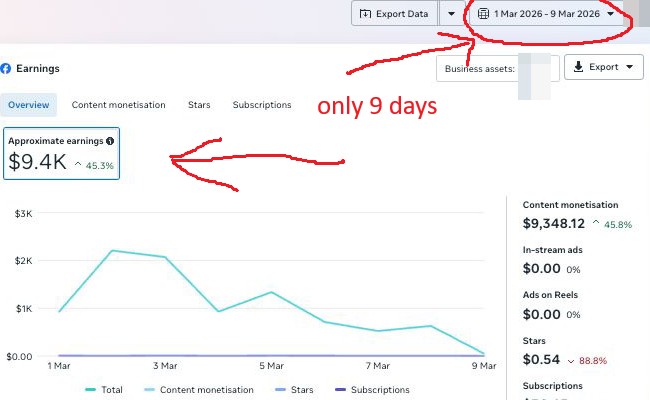
Want Your Page to Earn $30K+ a Month?
That screenshot is from one of our partner pages — $9,400 in just 9 days from Facebook Content Monetization. We work with page owners to set up, optimize, and scale their monetization. Drop your page URL below and we'll take a look.
Application Received — Here's What We Recommend
Your page doesn't currently qualify for the partnership. The good news: the path to monetization is well mapped, and you can start today.
Facebook Monetization Suite
Tools, automation, and strategy to grow your audience and unlock Facebook monetization.
Start Growing My Page →Facebook Elite Consulting
Personalized, hands-on guidance for established publishers who want to scale faster.
Get Expert Guidance →Once your page qualifies, you're welcome to re-apply for the partnership.
Facebook Reach Calculator
Estimate how many people your next Facebook post will reach. Calculate organic reach based on your engagement rate, plus paid reach from your boost budget — all in one place.
What Is Facebook Reach and Why Does It Decline Over Time?
Facebook reach is the number of unique people who see your content at least once. It differs from impressions, which count every time your post is displayed regardless of whether it is the same person. Reach is a better measure of actual audience exposure, and it is the foundation for calculating your engagement rate — both of which Facebook's algorithm uses to decide how widely to distribute your next post.
Organic reach on Facebook has fallen dramatically since 2014. Early pages could expect to reach 16% or more of their followers organically. Today, the typical organic reach for a Facebook page post is 2% to 6% of followers. Pages with smaller, more engaged audiences often outperform this average, while large pages with passive followers can see organic reach drop below 1%. This decline is largely by design — Facebook monetizes reach through paid promotion.
Reels and video content consistently achieve higher organic reach than text or photo posts because Facebook's algorithm rewards content formats that keep users on the platform longer. If growing your organic reach is a priority, shifting toward video and Reels content is the most impactful change you can make without spending on ads.
Facebook Organic Reach Benchmarks by Page Size
These are approximate organic reach rates (as a percentage of followers) observed across Facebook pages in 2024–2025:
| Page Size | Typical Organic Reach % | Example (10% engagement) | Notes |
|---|---|---|---|
| Under 10,000 | 8% – 15% | 800 – 1,500 people | Small pages get proportionally higher reach |
| 10,000 – 100,000 | 3% – 8% | 3,000 – 8,000 people | Mid-size average — video helps significantly |
| 100,000 – 1M | 1% – 5% | 10,000 – 50,000 people | Algorithm throttles organic to push paid |
| Over 1M | 0.5% – 2% | 5,000 – 20,000 people | Very large pages rely heavily on boosting |
How to Increase Your Facebook Organic Reach
- Post Reels Consistently: Reels receive the highest organic reach of any content format on Facebook right now. Even repurposing existing content as Reels can significantly extend your reach.
- Optimize Posting Times: Use Facebook Insights to identify when your audience is online and schedule posts for those peak windows. Timing has a measurable impact on early engagement, which drives further distribution.
- Encourage Meaningful Interactions: Comments and shares signal quality to Facebook's algorithm far more than reactions alone. Ask questions that invite real responses rather than just likes.
- Go Live Regularly: Facebook Live consistently receives 6x more reach than regular video. Even short, informal lives can reset your page's algorithm standing after a slow period.
- Cross-Post to Groups: Sharing content in relevant Facebook Groups (that you own or are approved to post in) multiplies your reach without additional ad spend.